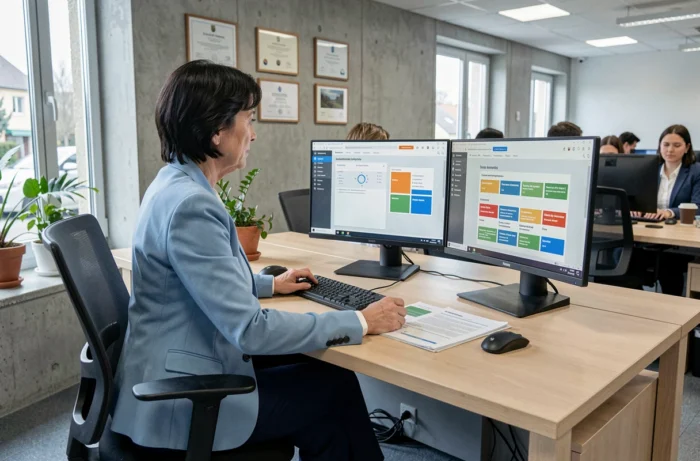
When a town hall’s general secretary manages payroll, council resolutions, civil records and accounting across four different software programs, with four logins and four export formats, every month-end becomes a balancing act. This is exactly the kind of day-to-day friction that Berger Levrault’s solutions for local authorities aim to eliminate by bringing administrative functions together on a single platform.
Take stock of existing tools before migrating to Berger Levrault
Before considering a rollout, start by assessing the current setup. Which software contracts are active? Which connectors handle the electronic transmission of official documents, DSN submissions or links to Chorus Pro? In Manche, the partnership between Manche Numérique and Berger Levrault specifically provides migration support that includes this preliminary inventory.
This step is more important than it might seem. Every existing interface can become a bottleneck if it is not mapped out in advance. For example, payroll software connected to the DSN through a third-party connector may need to be replaced or reconfigured. Skipping this step risks duplicate data flows or rejected electronic submissions during the transition.
Municipalities already using Berger Levrault software for town halls in one area, such as accounting, should check whether their contract allows them to activate other modules without renegotiating the entire agreement.
WeMagnus: financial management and payroll in one environment

WeMagnus, Berger Levrault’s SaaS solution for local authorities with fewer than 5,000 residents, brings accounting, human resources and public services together in a single interface. The platform has moved beyond the pilot stage and now supports the day-to-day management of many small municipalities.
Financial features include budget management, issuing payment orders and revenue notices, and a direct link to the public accountant. Payment orders can be entered and transmitted electronically from the same screen, eliminating intermediate XML or PDF exports.
The payroll module handles contribution calculations, payslip generation and DSN submissions. An employee managing payroll for a few dozen local government staff no longer needs to switch to dedicated software and then return to the accounting module to enter the corresponding transactions.
How centralization changes day-to-day work
The town hall of Saint-Hilaire-des-Landes, featured in a testimonial published by Berger Levrault, illustrates these benefits. Bringing tools together reduces manual data entry and helps prevent re-entry errors between two programs that do not communicate natively.
Working on the go is also easier: WeMagnus runs online and can be accessed through a browser. An elected official can review an administrative account or approve a council resolution from a tablet, without a VPN or local installation.
Cloud hosting and the security of municipal data
Centralizing municipal management on a cloud platform raises a legitimate question: what happens if there is an outage? Consolidating services with a single provider increases the risk that all functions will become unavailable at once. A server incident would no longer affect only accounting or payroll, but both at the same time.
Municipalities considering this migration should get written answers from the software provider or the public digital services operator (OPSN) on several points:
- How often backups are made and where they are stored, particularly whether data remains hosted in France, as Berger Levrault states is the case for WeMagnus
- The guaranteed recovery time in the event of a major incident, and the arrangements for degraded operation (read-only access, offline export)
- How data is segregated between local authorities using the same shared instance
- Commitments to comply with the threat landscape published by ANSSI, which regularly reports attacks targeting local authorities
Pooling services through an OPSN such as Manche Numérique makes technical support easier, but does not exempt each municipality from asking these contractual questions before signing.

Built-in AI assistant and e-invoicing: two projects to plan for
WeMagnus includes an artificial intelligence assistant powered by the publisher’s document library. In practice, users can ask it a regulatory question, such as how to calculate an elected official’s allowance or how to convene a town council meeting, and receive a contextualized answer.
This can be genuinely useful for a small municipality without its own legal department, provided users always check the source cited by the assistant. A decision-support tool is no substitute for review by a trained employee, especially on matters with financial or employment-status implications.
Get ready for e-invoicing reform
The e-invoicing reform, which is being phased in for all public-sector organizations and their suppliers, adds another requirement. Incoming and outgoing invoices will need to pass through compliant e-invoicing platforms.
A town hall already using a Berger Levrault solution connected to Chorus Pro will find the transition smoother than a municipality still processing invoices in spreadsheets. Checking now that the accounting module supports the required formats, such as Factur-X, can prevent a last-minute scramble when the requirements take effect.
Choosing municipal management software is about more than comparing features. The most useful question to ask before making a decision is still about taking stock: what data flows are in place today, between which tools, and which ones will still need to work tomorrow morning if the migration runs late?