
A ground-floor apartment overlooking the courtyard and the same apartment on the fifth floor with a continuous balcony can show a price difference of several tens of thousands of euros, in the same condominium, with identical surface area. Estimating the real value of a property first means understanding what creates this gap, and then seeking the data that confirms it.
DVF Data and Limitations of Real Estate Transaction Databases
Before comparing anything, we need real prices, not listing prices. The DVF database (Demandes de valeurs foncières) records sales registered by notaries and remains accessible for free. It is the most reliable foundation for estimating a property oneself.
The trap is to take this data at face value without looking at its freshness. The DVF database publishes sales with a delay of several months after the signing of the deed. In a fast-moving market, the snapshot is already outdated by the time it is consulted.
Another concrete limitation: DVF does not cover Alsace-Moselle or Mayotte. And above all, it does not provide information on the condition of the property, the floor, the brightness, or the energy performance diagnosis (DPE). Two houses sold on the same street a few months apart can show very different prices without the database explaining why.
For the comparison to make sense, one can discover info-immobilier.net in detail to cross-reference several data sources and better understand the prices practiced in a given area.
A local median calculated on few sales remains fragile. In rural areas or in a highly segmented neighborhood, five transactions are not enough to draw a trend. Local market analyses, such as those published for the municipality of Pau, recommend drawing conclusions only from at least ten sales in the same area.
Price per Square Meter: Why This Ratio Often Distorts Real Estate Estimation
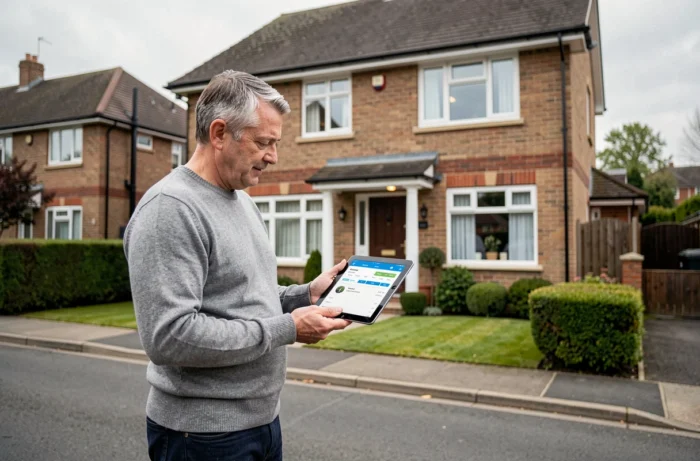
We hear everywhere about the price per square meter as a reliable indicator. In reality, the price per square meter masks the characteristics that determine a property’s value. A 20 m² studio sells proportionally more expensive per square meter than an 85 m² T4 in the same building. This is not an anomaly; it’s mechanical: small surfaces incorporate a floor price related to fixed costs (kitchen, bathroom).
Comparing two properties solely on this ratio ignores what really weighs in the purchase decision:
- The layout and distribution of rooms, which determine whether the area is truly usable or if it includes hallways and lost corners
- The orientation and natural light, an east-west facing living room is not as attractive as a north-facing living room
- The condition of common areas and works voted on in the condominium, which can represent an immediate cost for the buyer and affect the sale price
- The presence or absence of a private outdoor space (balcony, terrace, garden), a factor often underestimated in raw comparisons
For a house, the land adds an additional variable. Two houses with the same living area on very different sized plots have nothing comparable per square meter.
DPE and Property Value Estimation: An Unstable Criterion
The energy performance diagnosis now weighs in negotiations. A property rated F or G suffers a discount at sale, while a good rating reassures buyers about their future expenses. The problem is that the DPE of the same property can change without any work being done.
Analyses published on data.gouv.fr show that the reform of the calculation method has changed the rating of millions of properties. A property rated E before the reform can end up rated D or F according to the new coefficients applied. Comparing two estimates made at different times without checking the calculation method of the DPE used is comparing things that are not comparable.
Check the Date and Method Before Comparing
When consulting a listing or a past sale, note the date of the DPE and the regulatory version used. A DPE conducted before the last reform does not have the same informative value as a recent DPE. Cross-referencing the DPE with the year of construction and the type of heating allows for spotting inconsistencies and anticipating a possible reclassification.
In a market where thermal sieves are negotiated more harshly, this verification prevents overestimating a property whose rating may degrade, or underestimating a property whose DPE has simply not been updated.

Listed Price and Actual Sale Price: Distinguishing Market Value from Listing Price
A common reflex is to look at online listings to get an idea of the price. What we see in the listings are starting prices, not sale prices. The majority of sales in the old market are subject to negotiation, and the gap between the listed price and the signed price can reach several percentage points.
This distinction has a direct consequence on estimation. Basing one’s price on listings in the neighborhood risks overvaluing one’s property. Real transaction databases (DVF, notarial data) provide the actual price paid, after negotiation.
Property Liquidity and Sale Timeframe
Estimating a coherent price does not guarantee a quick sale. Liquidity also depends on the type of property, the size of the pool of potential buyers, and the timing of the sale. An atypical property (large area, unusual configuration, isolated location) may have a high theoretical value but a long sale timeframe, due to a lack of buyers matching the profile.
Estimating the value of a property also means estimating how long it will take to sell at that price. A gap of a few thousand euros on the initial price can make the difference between a sale in a few weeks and a property that stagnates for several months, losing attractiveness as its publication duration increases.
The last point to keep in mind: no online estimation, no matter how sophisticated, replaces the confrontation with reality. Algorithms work on averages and histories. They do not see the view, the street noise, or the humidity in the basement. Cross-referencing statistical data with a careful visit to the property and its immediate surroundings remains the most reliable method to approach the real value of a home.