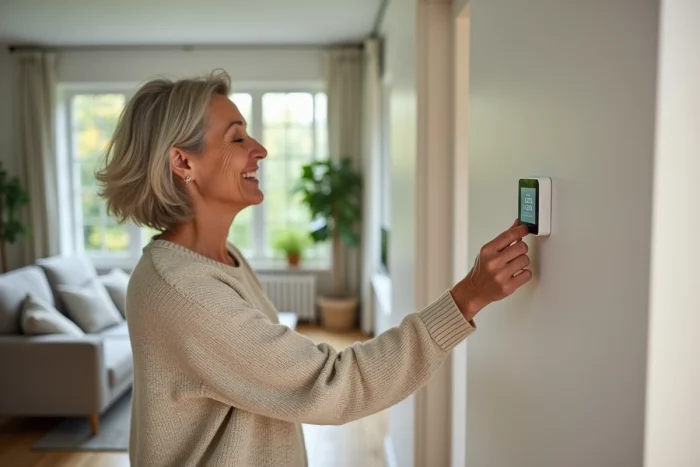
Home automation does not systematically guarantee a reduction in energy consumption. Some technologies, although designed to optimize well-being, can exacerbate heat peaks inside homes, despite significant investments.
In collective housing, digital and ecological solutions sometimes struggle to adapt to the diversity of actual uses. The latest technical advancements are now seeking to address these contradictions by balancing comfort, energy performance, and compliance with new climate requirements.
Connected Habitat: Where Do We Stand Today?
Now, the smart home is establishing itself as a true testing ground. Connected devices, whether managing energy or security, are changing the way we live. Lighting that adjusts automatically, thermostats capable of anticipating your needs, shutters that respond to voice commands via Alexa or Google Assistant: each device works to shape a personalized comfort, accessible at your fingertips or through voice commands.
Intelligent energy management is now at the center of attention. The latest systems no longer just provide a simple assessment of consumption: they calculate, predict, and adjust the use of each kilowatt. Installing solar panels connected to batteries allows for partial, or even total, autonomy, depending on the household’s habits. These choices rely on real-time data, which cross-reference production and usage to refine each setting.
The combination of safety, energy performance, and comfort is embodied in today’s constructions and renovations. Thanks to financial aids aimed at supporting energy renovation, solutions once reserved for science fiction are becoming accessible. Habitat solutions services push innovation further by seeking a balance between sobriety, simplicity, and efficiency.
But one challenge remains: how to bring together autonomy, reduction of energy consumption, and fine adaptation to real lifestyles? The answer is being invented day by day, with a clever mix of technology, understanding of usage, and tailored advice. The habitat is transforming into a true living laboratory, where each innovation aims to enrich daily life without ever sacrificing simplicity.
What Innovations for Optimal Comfort in Your Home?
Thermal comfort no longer depends on luck or inherited habits. Advances in thermal insulation are profoundly changing the way we live at home. Forget cold walls and discreet drafts: effective insulation, combined with triple-glazed windows, stabilizes temperature and significantly reduces heating or cooling needs. This technical choice immediately influences energy consumption and the sense of well-being in your home.
Another ally of comfort, controlled mechanical ventilation (CMV) is making its entrance, especially in its double-flow version, to maintain air quality at an optimal level. It renews the air, combats humidity, blocks pollutants, and adjusts everything based on the actual needs of the inhabitants.
To clarify the benefits of these innovations, here are the main improvement levers:
- Improvement of insulation: walls, attics, floors are reinforced
- Double-flow CMV: priority to healthy and renewed indoor air
- Triple-glazed windows and enhanced shading to limit heat loss
Lighting also occupies a prime position. Thanks to LEDs, adaptive systems, and adjustable ambiance scenarios, each space adopts the atmosphere that suits it while limiting energy expenditure. These developments, designed to improve comfort and preserve autonomy, position technology as a discreet tool, serving daily life.
Adapting the habitat involves a precise diagnosis: each home deserves a tailored study to closely align with expectations and uses. Comfort is not improvised; it is built piece by piece, with care and relevance.

Optimizing Summer Comfort in Collective Housing: Technical and Ecological Solutions to Prioritize
In the face of rising temperatures in dense neighborhoods, tangible solutions are needed. Urban heat islands weigh heavily on well-being, transforming life in collective buildings. To counter this phenomenon, targeted energy renovation makes a difference. Recent habitat solutions, guided by a concern for sustainable development, combine cutting-edge insulating materials and passive devices to gain freshness.
Here are the key strategies that make a difference in limiting overheating and improving summer quality of life:
- Reinforcement of thermal insulation of facades to slow down external heat
- Vegetalization of roofs and facades to establish a natural barrier
- Installation of adjustable sunshades, exterior blinds, and dynamic shading
Assisted natural ventilation, combined with intelligent management of openings, allows for cooling the interior without spending more energy. Using rainwater to irrigate green spaces or cool communal floors enhances this effect while preserving public resources.
Reducing Energy Consumption, Improving Your Comfort
Energy renovation operations now include rigorous monitoring of energy consumption. Real-time measurement, data display, experience sharing among co-owners: each innovation is part of a collective effort. Achieving sustainable summer comfort requires mastering flows, choosing efficient equipment, and anchoring oneself in local reality. Support from a public service or a specialized company helps find the right balance between technology, efficiency, and quality of life.
The home of today, connected, ventilated, insulated, no longer just meets demand: it anticipates expectations, pushes the limits of comfort, and redefines, each season, the very notion of well-being at home.