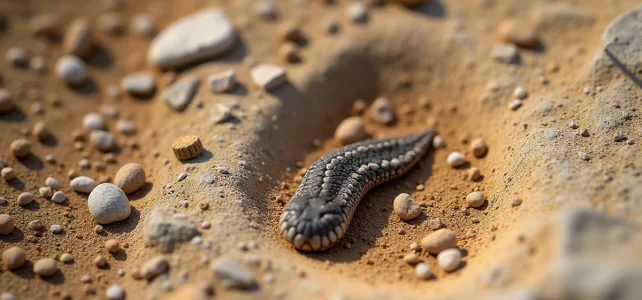
Snake droppings share some visual traits with those of small mammals or birds. Correctly identifying these droppings relies on specific criteria: a two-component structure, prey remnants, color, and texture. This guide details the measurable elements that allow one to distinguish a snake dropping from that of another animal, and what each clue reveals about the concerned reptile.
Snake Droppings Compared to Other Animals’ Droppings
The most common confusion involves the feces of small mammals (hedgehogs, weasels, rats) and those of birds. The table below summarizes the observable distinguishing criteria without specific equipment.
Read also : How to Get TV Channels with Xiaomi Stick TV 4K: Guide and Practical Tips
| Criterion | Snake | Small Mammal | Bird |
|---|---|---|---|
| Structure | Dark sausage + white mass (urates) attached | Separate, uniform droppings | Semi-liquid droppings, mixed white and dark |
| Visible Urates | Yes, always (chalky white to yellowish) | No | Yes, but integrated into the liquid droppings |
| Prey Remnants | Fragments of bones, scales, fur, sometimes feathers | Seeds, plant fibers, insects | Insect exoskeletons, seeds |
| General Shape | Elongated, sometimes irregular, curved | Regular cylindrical or pellet-shaped | No defined shape |
| Odor | Strong, musky | Variable, often mild | Acidic, ammonia-like |
The most reliable criterion remains the simultaneous presence of white urates and dark fecal matter. Snakes expel solid and urinary waste through a single opening, the cloaca. This dual component is absent in mammals.
To visually compare these differences, there are photos of snake droppings that facilitate field recognition.
Further reading : How to Recognize Spirit Syndrome in 5-Year-Olds: Symptoms and Tips
Urates and Prey Remnants: Two Key Clues for Identification
Urates constitute the solid urinary fraction of reptiles. In snakes, they appear as a white to pale yellow mass, often chalky or slightly pasty, attached to the brown or black fecal part. Very yellow or orange urates indicate dehydration or a renal issue in the animal.
The fecal part directly informs about the diet. A dropping from a grass snake found in a garden will typically contain fragments of rodent bones, sometimes clumped fur. In species that consume amphibians, the texture is smoother, with fewer hard debris.
Observable Remnants Depending on Prey Type
- Rodents: small long bones, clumped fur, sometimes visible claws to the naked eye
- Amphibians or fish: more homogeneous droppings, few solid fragments, sometimes gelatinous texture
- Insects or invertebrates (small grass snakes, earthworms): fragments of exoskeleton, lighter color
- Birds (rarer case, large grass snakes): partially digested feathers, recognizable hollow bones
This analysis of remnants allows one to deduce which prey frequent the area, and thus what type of snake likely resides there.
Wild Snake Droppings vs. Terrarium Snake Droppings: Noticeable Differences
A snake that has escaped from a terrarium does not produce the same droppings as a wild snake. Captive snakes, fed with standardized frozen prey (mice or farmed rats), generate droppings that are more uniform in size and texture, with fewer visible fragments. The digestion of homogeneous prey results in more uniform fecal matter.
In contrast, a wild snake consumes a variety of prey (amphibians, lizards, rodents, birds) whose remains create more heterogeneous droppings. Finding very “clean” and regular droppings in urban or suburban areas may indicate an animal that has escaped captivity.
Grass Snake Droppings in the Garden: An Indicator of Local Biodiversity
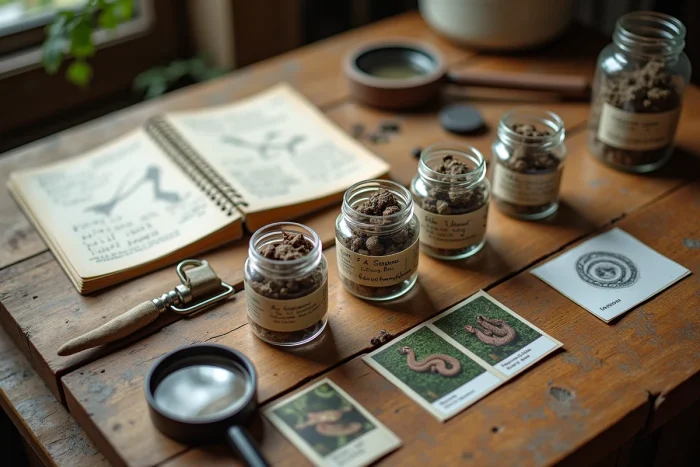
The regular presence of grass snake droppings in a garden is not a warning signal. It is, on the contrary, a positive indicator of biodiversity. It implies the existence of a network of varied prey (rodents, amphibians) and a still functional environment: hedges, wood piles, wetlands, or compost.
A garden where these droppings are found thus hosts an active ecosystem. The grass snake naturally regulates rodent populations and contributes to soil balance.
Health Precautions in Case of Discovery
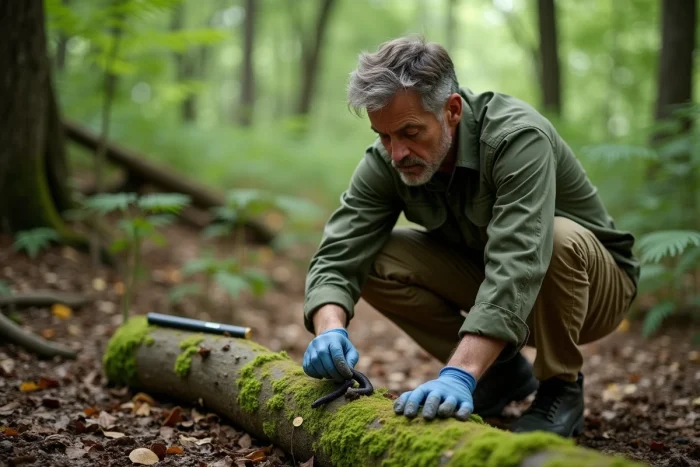
Reptile droppings are frequently carriers of Salmonella, even in apparently healthy snakes. Handling with bare hands is to be avoided. Cleaning involves wearing disposable gloves, using a tool (shovel, thick absorbent paper) for collection, and then disinfecting the contact area.
- Never touch droppings with bare hands, even if dried
- Use a disinfectant on the surface after removal
- Wash hands thoroughly after any handling, even with gloves
The risks mainly concern young children and immunocompromised individuals. A snake in the garden does not warrant panic, but imposes a strict hygiene around the droppings areas.
Ultimately, recognizing a snake dropping relies on a simple reflex: look for the dual fecal-urates component, then examine the prey remnants. These two observations are sufficient to eliminate most confusions with other animals and to understand which snake frequents the area.