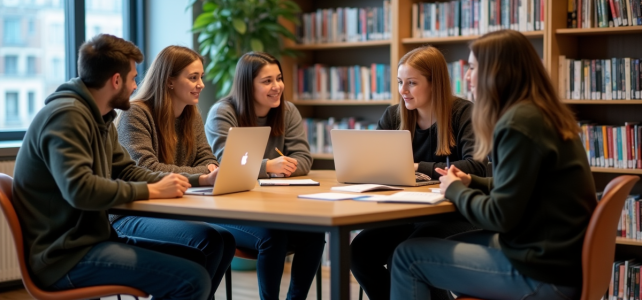
Every year, more than 85% of French students use at least one digital platform to attend classes or submit assignments. However, a majority of teachers express doubts about the actual effectiveness of these tools in educational support. Between increased autonomy and information overload, the balance remains fragile.
The numbers speak for themselves: digital technology occupies an increasingly large share of the educational landscape. Despite this progress, access is not the same for everyone, and the quality of learning still sparks lively debates within the academic community. With artificial intelligence taking hold, new questions are shaking up the old benchmarks of classrooms.
See also : Cybersecurity in Business: What Solutions for SMEs?
When Digital Technology Invades Student Life: Between Promises and Questions
Digital technology has become central to student pathways, becoming a driver of success and a factor of inclusion in higher education. Across France, from universities to grandes écoles, investments are piling up to develop platforms, reinvent training, and adapt educational support. Digital workspaces are changing the game: centralization of courses, management of schedules, administrative procedures in just a few clicks. The result? Increased autonomy, simplified organization. Many see these digital services as a real turning point: the relationship to knowledge is evolving, the teacher becomes a guide, more than just a transmitter.
But the digital divide is anything but theoretical. On the ground, it translates into concrete inequalities: where some benefit from high-performance tools, others struggle to access resources or utilize all available features. This reality raises a burning question: will institutions be able to guarantee the same opportunities for all? The GIP Renater may be strengthening connectivity in universities, but some students remain marginalized from the system. The difficulties do not simply evaporate with a flick of optical fiber.
Read also : Nexterprise: the new benchmark for guiding entrepreneurs to success
A national coordination is being organized: COREAL, with its 2023-2027 roadmap, aims to transform digital technology in higher education and research through 26 ambitious measures, including accessibility, security, data sovereignty, and openness. The DGESIP is driving these changes, but the reality varies from campus to campus. Students, for their part, expect responsive platforms tailored to their needs, capable of integrating educational resources and collaborative tools like UTC ENT. The question is no longer just technical, but pedagogical: it is about rethinking methods, training, and research to build a fairer and more innovative society.

Platforms, AI, Time Management: How Digital Tools Redefine Academic Success
It is impossible to ignore the growing impact of digital platforms on the daily lives of students and teachers. They no longer just store files: they organize university life, from lectures to administrative registrations. MOOCs and SPOCs make training accessible far beyond traditional boundaries, while allowing for personalized support and real-time adaptation to individual needs. The rise of these tools fosters the emergence of transversal skills: autonomy, project management, remote collaborative work.
Artificial intelligence is no longer a conference topic; it is integrated into the heart of the student experience. Personalized recommendations, analysis of learning data, content adaptation: pedagogy is taking on a new face. Teachers, supported by these technologies, orchestrate evolving systems. Students, for their part, optimize their time with synchronized calendars, automatic reminders, and smart notifications. The schedule tightens; every slot counts.
Here are some concrete examples of this digital transformation:
- To meet the specific needs of students with disabilities, Cartable fantastique offers adapted interactive exercises.
- Solutions like Cantoo Exams or RIDISI facilitate access to exams and reading, promoting tailored support.
- Creativity and collaboration take on a new dimension through the creation of educational videos via Polymny Studio or the design of educational materials in teams.
The personalization of pathways is becoming tangible, driven by renewed pedagogical engineering and resources tailored to each student profile. These digital tools, far from being mere gadgets, are establishing themselves as partners in success, inclusion, and pedagogical transformation.
It remains to be seen how far this digital revolution will take higher education: towards true equality of opportunity or new lines of division? History is being written, and every connected student is now an actor in it.